Brendan Benetti
January 16, 2020
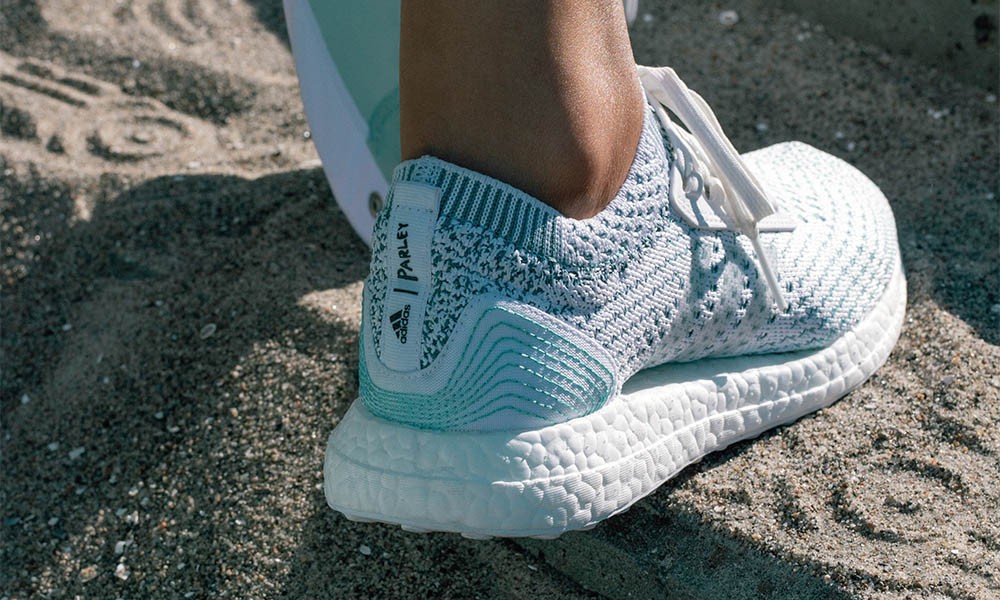
A sneak(er) peek
The sneaker industry is a multi-billion dollar global market despite being targeted as one of the most wasteful retail items to produce; an estimated 23 billion pairs of sneakers are manufactured annually, according to a Business Insider report. The majority of new sneaker manufacturing entails the use of virgin plastics, rubber, and petroleum which produce an unhealthy amount of CO2. Waste reduction has largely been prioritized in recent years by educated consumers who are proponents of sustainability and responsible consumption and production. Environmental impacts and concerns with the production of food, energy, and the retail industry relate heavily to the objectives of SDG 1 – responsible consumption and production. Consequently, large corporations are incentivized to appease the sustainable attitudes of the consumer by adopting greener technologies and methods to both the production and marketing of their products. By prioritizing corporate social responsibility, consumers are more inclined to purchase goods that have been responsibly reused, produced or recycled, despite the generally higher price tag.
Approximately 300 million pairs of sneakers are thrown out annually, each taking an estimated 30-40 years to decompose in landfills due to the overwhelming use of virgin plastics, rubber and petroleum products and by-product. In addition to the long time-frame of decomposition, the products used to contribute to a large number of carbon emissions during production which has been proven to have adverse effects on the climate, and are toxic to wildlife.
Mainstream athletic companies like Adidas have been a major contributor to internal waste reduction policies when it comes to producing and manufacturing one line of their running shoes. In 2015, global sportswear giant, Adidas partnered with Parley; an environmental activist group prioritizing the address of major threats to the world’s single most important ecosystem on the planet, the ocean. Together they have created a sneaker that is made from materials acquired by recycling ocean plastic; the Adidas x Parley Ultraboost.
Sourcing of Materials
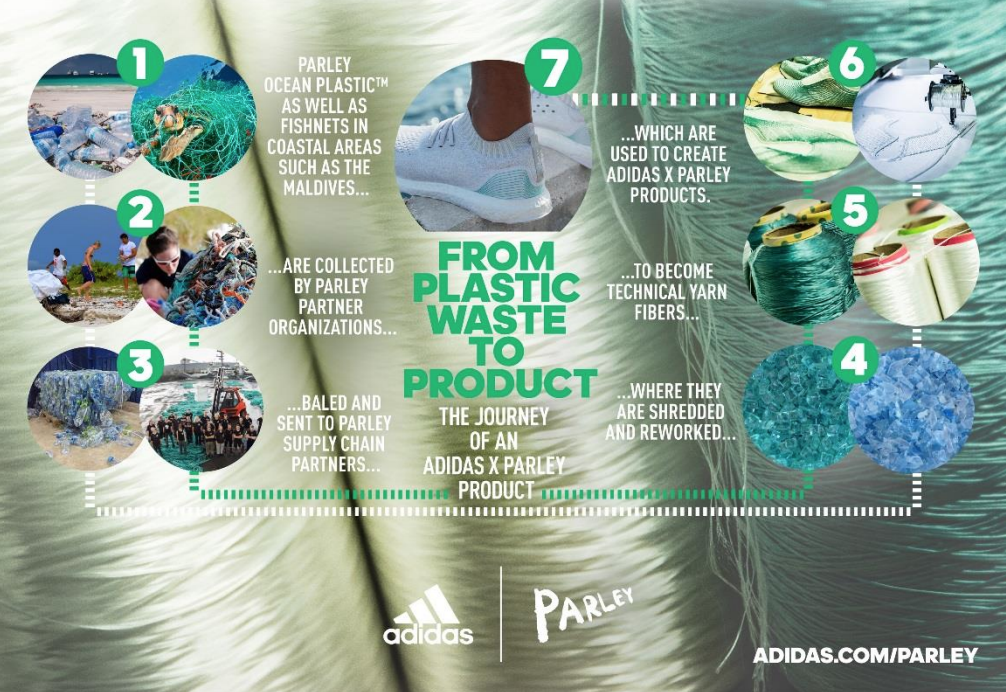
Parley and its partner organizations source ocean plastic, the majority of which is comprised of plastic bottles and packing material procured from the coastal regions, primarily in the Maldives. Plastic is collected in the Maldives by local partner organization’s which is then sorted, bagged, and transported by shipment vessel to Taiwan where the plastic is recycled and converted into fibers which are reused in the manufacture of the ultra boost shoes.
Although responsible consumption and production is a primary objective in the sourcing of materials, the extraction and transportation of ocean plastic to the factory requires the use of fossil fuels to power the ship vessels and equipment used to extract and move the plastic from the water. Carbon emissions and the consumption of natural resources are an unfortunate by-product of this process. Transportation by sea is arguably the most commonly used in the commercial transportation business and it is often viewed as the most sustainable method of large scale product transport. Adidas has justified inquiries addressing concerns that the pollution caused by transporting the plastic to Taiwan outweighs the benefits of its collection in the first place; the company stresses that its priority, first and foremost, is to combat plastic pollution. Adidas is working with Parley and its partner organizations to increase plastic collection locations in an attempt to minimize and reduce transportation impact on the environment.
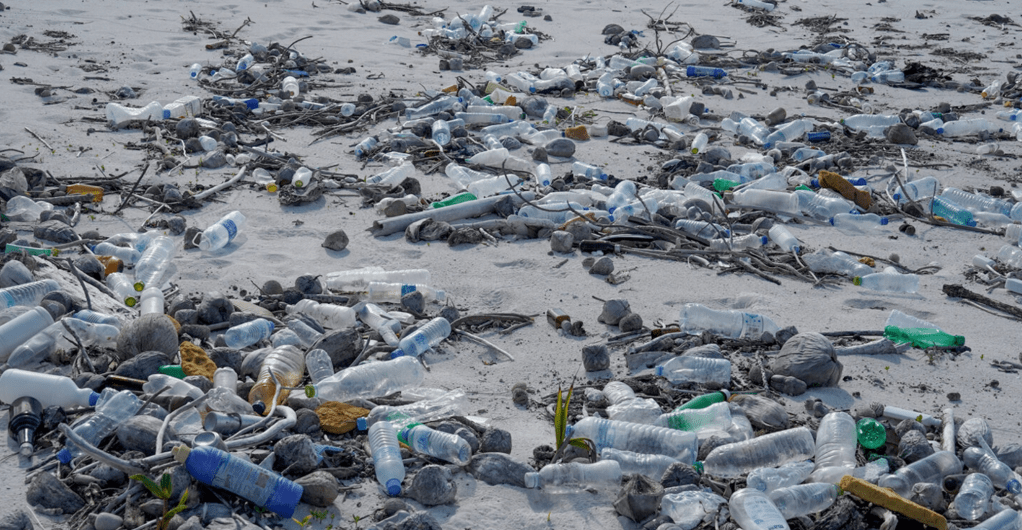
©Caroline Power A Maldive beach prior to a Parley team conducting a clean-up; littered with plastic water-bottles.
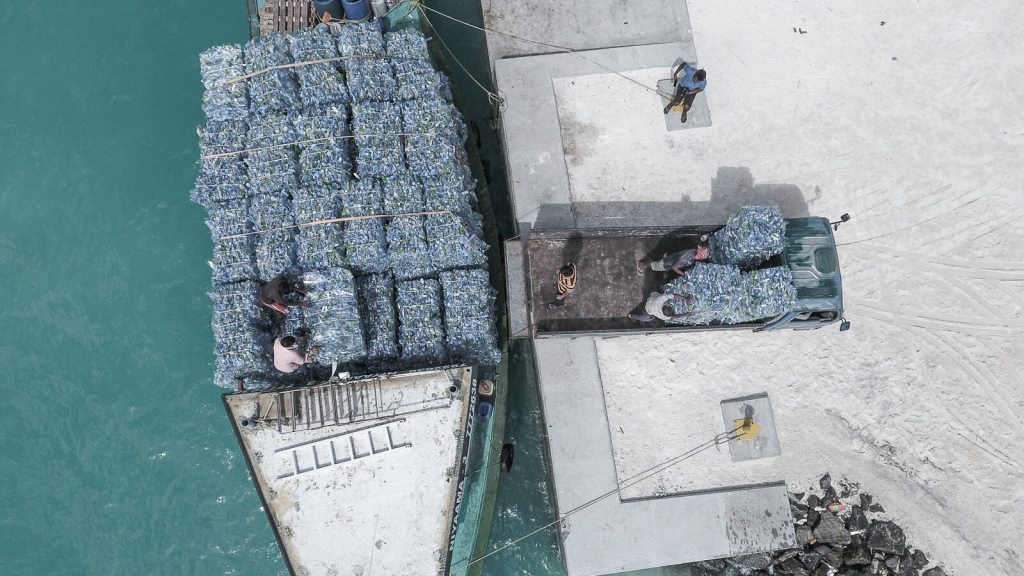
©Parley.tv Plastic that has been collected in the Maldives, now being loaded onto one of the boats to be transported to a sorting facility.
Manufacture
Parleys supplier, FENC (Far Eastern New Century Corp) has been recognized as one of the leading innovators and manufacturers of environmentally conscious fiber. The company has the highest recycling rate of bottles into fibers globally and is a leading innovator in the textile dye industry. The plastic is put through an initial process of crushing, washing, and dehydration. The second stage consists of washing, screening and eventually chopping the plastic into small pellets; the pellets are then melted into filament which is eventually spun into yarn which is used in the manufacture of their shoes. Any plastic that is unusable to Adidas is responsibly dealt with by being sent to normal recycling facilities. Adidas prioritizes the reuse and elimination of virgin plastic over the methods used to manufacture, however, the process of recycling polyester does use less water and fewer chemicals, ensuring less virgin plastic is unnecessarily introduced into the environment.
Parley plastic process
After Use Management
Currently, Adidas does not prioritize the after use management of their products directly, choosing instead to focus more on the responsible procurement of resources. The objective of the partnership with Parley is to clean up the world’s oceans and keep plastic materials from entering global waters and subsequent negative implications on ocean wildlife and human life. Although the “cradle to grave” idea is not the driving force nor the primary objective behind the collaboration in the production of the Adidas x Parley line of products it has had a significant impact on consumer behavior regarding running shoes. The success of the Adidas X Parley running shoes from both a business and consumer point of view provided the incentive for Adidas to iterate on the environmentally friendly running shoe and subsequently fortify and improve upon the companies resilience strategy towards the elimination of virgin plastic. The recent release of the “Futurecraft Loop” is the companies beta version of its first 100% recyclable shoe, which the company hopes will incentivize consumers to embrace a “reuse and recycle” mentality by returning the shoe after it has been worn down in order for it to be ground up and re-created. This approach is all part of Adidas’ contribution to a circular economy in the retail sneaker market.
References
Adidas. (n.d.). Q&A Adidas x Parley Partnership. Retrieved February 4, 2020, from https://www.adidas-group.com/media/filer_public/16/29/16299d3c-ad48-4f62-a8ef-c44c25fa4e5a/adidas_x_parley_qa_website_en.pdf
Aziz, A. (2018). The Power of Purpose: How Adidas will make $1 billion helping solve the problem of ocean plastic. Retrieved February 10, 2020, from https://www.forbes.com/sites/afdhelaziz/2018/10/29/the-power-of-purpose-how-adidas-will-make-1-billion-helping-solve-the-problem-of-ocean-plastic/#2c7b28a7d215
Creativity versus Plastic. (2019). Retrieved February 4, 2020, from https://www.adidas.ca/en/blog/361041
Design Life-Cycle. (2018). Life Cycle Assessment of the Adidas x Parley Ultraboost. Retrieved January 27, 2020, from http://www.designlife-cycle.com/life-cycle-assessment-of-the-adidas-x-parley-ultraboost
Ismael, A. (2020). 9 footwear brands that make sustainable sneakers from recycled and renewable materials. Retrieved February 2, 2020, from https://www.businessinsider.com/sustainable-sneaker-brands
Materials. (n.d.). Retrieved January 27, 2020, from https://www.adidas-group.com/en/sustainability/products/materials/
Morgan, C. (2019). Adidas is turning plastic ocean waste into sneakers and sportswear. Retrieved February 2, 2020, from https://www.businessinsider.com/adidas-sneakers-plastic-bottles-ocean-waste-recycle-pollution-2019-8
Parley Maldives. (n.d.). Retrieved February 9, 2020, from https://www.parley.tv/updates/parleymaldives?rq=maldives
Parley.TV. (2019). [Photograph]. Retrieved February 18, 2020 from https://www.parley.tv/updates/parleymaldives?rq=maldives
Power, C. (2017). [Photograph]. Retrieved February 18, 2020, from https://www.parley.tv/updates/2020/state-of-the-oceans-71
Scott, M. (2014). Sustainable shipping is making waves. Retrieved January 30, 2020, from https://www.theguardian.com/sustainable-business/2014/aug/01/sustainable-shipping-is-making-waves
The Maldives Plastic Warriors. (2019). Retrieved January 25, 2020, from https://www.themaldivesexpert.com/5383/the-maldives-plastic-warriors/
Follow My Blog
Get new content delivered directly to your inbox.
 SDG's in Action